Smoother Approvals
Submitting a compliant, well-written report speeds up your City of Melville DA process.
Professional, council-ready tree reports for development, safety, and compliance.
Consulting arborist services in Ardross and Melville.
Whether you are subdividing a block in Ardross or need to justify the removal of a dangerous tree, our AQF Level 5 reports provide the professional weight you need.
With the ongoing LPS6 review and the strict R-Code canopy rules, developing in Ardross requires precise arborist documentation to calculate deep soil areas and protect significant vegetation.
Submitting a compliant, well-written report speeds up your City of Melville DA process.
Our AS4970 plans ensure retained trees survive the construction phase.
AQF Level 5 assessments hold up in disputes and council appeals.
We discuss your project requirements and council requests.
Our consulting arborist visits your Ardross property to assess tree health, structure, and dimensions.
We calculate Structural Root Zones (SRZ) and Tree Protection Zones (TPZ).
You receive a comprehensive, formatted PDF report ready for submission.
If you are planning a development, resolving a neighbour dispute, or managing large remnant trees on your property, securing a professional Arborist Report Ardross is the critical first step. Situated on the Swan Coastal Plain between the Swan and Canning Rivers, Ardross featuress and 1970s blocks dotted with towering remnant tuarts, jarrahs, and heavily planted jacarandas. As these trees mature on deep Spearwood sand, they require expert assessment to ensure they remain safe and structurally sound during intense winter cold fronts and sudden summer sea breezes.
Our team at Melville Arborist provides comprehensive, AQF Level 5 consulting arborist reports. Whether you need an AS4970-compliant tree protection plan for a new architectural build or a detailed risk assessment for a declining Brisbane box tree, we deliver the precise, authoritative documentation required by local authorities and builders. We deeply understand the specific environmental and regulatory pressures within the City of Melville, ensuring your project moves forward safely and without costly delays.
Many property owners and developers mistakenly assume that a simple quote or a brief letter from a standard tree lopper is sufficient to satisfy council or insurance requirements. Unfortunately, submitting under-qualified documentation is a guaranteed way to have your Development Application (DA) rejected by the City of Melville. This leads to frustrating delays, blown construction budgets, and potential legal complications.
A proper tree assessment requires a profound understanding of tree biomechanics, local soil conditions like our coastal sands, and specific regulatory frameworks. Without this specialised expertise, critical issues such as hidden root decay, structural weaknesses in a massive lemon scented gum, or the early signs of the Polyphagous Shot Hole Borer can be easily missed. Conversely, an unqualified assessment might unnecessarily condemn a healthy tree that could have been safely retained with targeted, AS4373-compliant pruning.
As fully qualified consulting arborists, our team provides robust, legally defensible documentation. We utilise advanced Visual Tree Assessment (VTA) methodologies to accurately evaluate tree health, structural integrity, and Safe Useful Life Expectancy (SULE). By engaging us, you ensure that your tree management decisions are backed by rigorous scientific evidence and meet all Australian Standards, protecting you from liability and unnecessary expenses.
We produce a range of highly specialised arborist reports tailored to your specific project needs. Every document is strictly aligned with industry best practices and required regulatory standards.
We conduct comprehensive tree inventories for your site, identifying exact species, recording Diameter at Breast Height (DBH), and calculating SULE ratings. This report provides clear retention recommendations essential for R-Codes Volume 1 compliance and local council DA submissions.
Critical for construction sites, we specify exact Tree Protection Zones (TPZ) and Structural Root Zones (SRZ). We detail the required protective fencing, root mapping procedures, and supervised work zones to ensure retained trees survive the building process unharmed.
Following internationally recognised VTA and QTRA principles, we document structural defects, potential target zones, and the likelihood of failure. This is vital for duty-of-care documentation on residential acreage, strata, or commercial properties dealing with large overhanging canopies.
When a protected remnant tuart or jarrah requires removal, we provide the robust justification needed to satisfy the Environmental Protection Act. We document the tree's hazardous condition, structural decline, and outline any necessary replanting recommendations.
Securing your Arborist Report Ardross is a streamlined, transparent process designed to give you clarity and compliance from day one. It begins when you contact our team to discuss your project—whether it is a pre-purchase property inspection, a complex DA submission requiring deep soil area calculations, or a risk assessment for a towering WA peppermint tree.
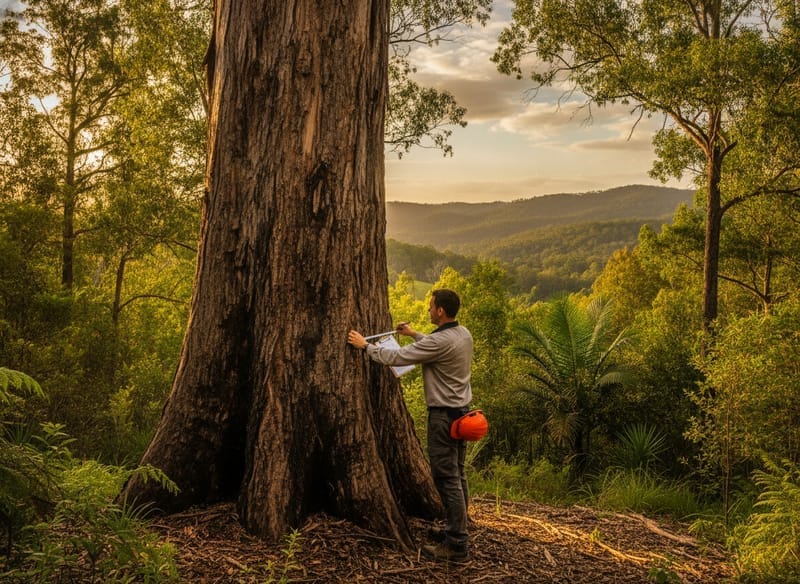
Next, our AQF Level 5 consulting arborist conducts a detailed site visit. We measure trunk diameters, map the exact locations of the trees, and perform thorough visual inspections to identify pests, systemic diseases, or structural flaws. For development sites, we overlay this data directly onto your architectural plans to accurately calculate Tree Protection Zones (TPZ) and assess structural impacts from proposed earthworks.
Back at the office, we compile these findings into a detailed, highly structured PDF document. The report outlines clear methodologies, photographic evidence, hazard ratings, and actionable recommendations.
Finally, we deliver the completed report directly to you or your project manager. If the report recommends remedial pruning or complex tree removal, our fully insured AQF Level 3 climbing arborists and heavy machinery operators are fully equipped to execute the physical tree work flawlessly.
Every report drafted by our team is authored by an AQF Level 5 (Diploma of Arboriculture) consulting arborist, the exact qualification mandated by local authorities for formal tree documentation. We are fully insured, carrying comprehensive public liability and professional indemnity insurance, giving you total peace of mind.
Our recommendations strictly adhere to AS4970 — Protection of Trees on Development Sites for managing construction impacts, and AS4373 — Pruning of Amenity Trees when remedial works are advised. We completely reject harmful practices like topping or lopping, ensuring all prescribed works promote long-term tree health, structural stability, and safety for your property.
Working in Ardross and neighbouring river-frontage suburbs like Applecross and Mount Pleasant requires deep local knowledge. While the City of Melville Local Planning Scheme No. 6 (LPS6) currently has no general tree protection on private land, remnant native vegetation—like our mature tuarts, jarrahs, and marris—is often protected under the state Environmental Protection Act 1986. This means clearing native canopy frequently requires a formal permit backed by a professional arborist report.
Furthermore, the entire City of Melville sits squarely inside the Polyphagous Shot Hole Borer (PSHB) Quarantine Area. High-risk host species prevalent in Ardross, such as box elder maples and coral trees, require careful monitoring and specific waste-handling protocols. Our reports explicitly factor in these biosecurity requirements. We also account for the unique local climate, assessing how sudden autumn convective thunderstorms and severe winter cold fronts on deep, saturated sand impact the stability of top-heavy eucalypts.
Once you receive your completed arborist report, the immediate next steps depend heavily on your project goals. For developments, you must implement the specified AS4970 tree protection fencing before any heavy machinery enters the site. It is critical that you do not alter soil levels, trench, or store building materials inside a designated Tree Protection Zone. If your report recommends hazard reduction pruning, deadwooding, or the safe removal of a declining tree, contact our team to schedule the physical work. Our expert climbers will execute all required cuts strictly to AS4373 standards. For the ongoing management of significant retained trees, we recommend scheduling follow-up visual inspections every two to three years, or following severe winter storms, to ensure your canopy remains safe and thriving.
Consulting work is priced based on the number of trees and the complexity of the project.
Contact us with your project details for a fixed-fee proposal.
Consulting arborist services for developers and homeowners in Melville.
Contact our AQF Level 5 consulting arborist for a fixed-fee proposal today.
Get a Quote