Smooth Council Approvals
Submit DA paperwork that meets City of Melville standards the first time, preventing costly delays.
Professional, AQF Level 5 arborist reports for Development Applications, risk assessments, and tree management.
Providing expert arboricultural consultancy in Bicton.
Our Arborist Report Bicton services provide the formal documentation required for planning, development, and risk management.
With Bicton's large block sizes and high development potential, navigating the retention of mature tuarts and jacarandas alongside R-Code deep soil rules requires precise arborist documentation.
Submit DA paperwork that meets City of Melville standards the first time, preventing costly delays.
Document the condition of potentially hazardous trees to protect yourself from liability.
Ensure construction activities don't inadvertently kill significant amenity trees on your block.
We discuss your specific needs—whether it's a DA, a risk concern, or a dispute.
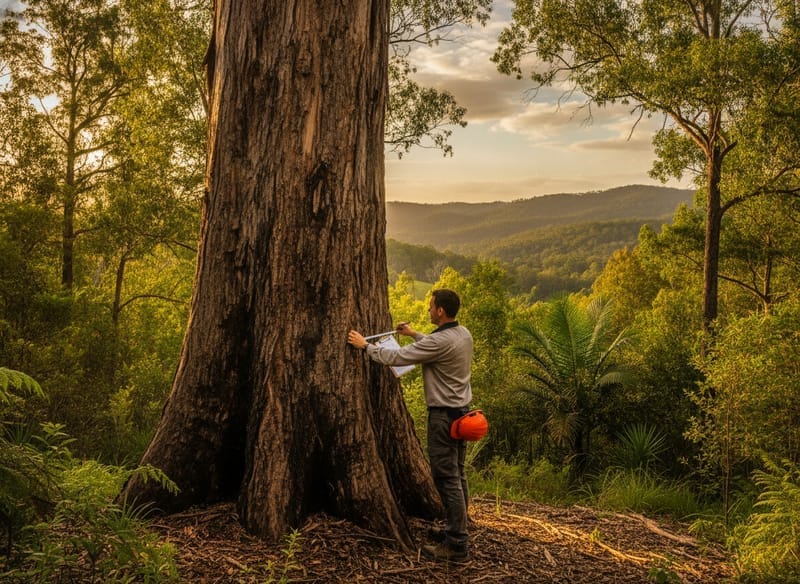
Our AQF Level 5 arborist attends the site to measure, photograph, and assess the trees in question.
We calculate TPZ and SRZ metrics and analyze the health and structural integrity.
You receive a comprehensive, professionally formatted PDF report ready for submission.
If you are planning a development, resolving a boundary dispute, or managing aging remnant trees on your block, you need precise, professional arboricultural documentation. Bicton’s leafy character is defined by its mature canopy, featuring towering remnant tuart and jarrah trees alongside decades-old planted jacarandas and lemon scented gums. As these trees mature on large traditional blocks, and as infill development increases, the intersection of construction and tree preservation requires expert management.
Whether you are a homeowner, builder, or property manager, securing a comprehensive Arborist Report Bicton ensures your project moves forward without costly delays. Our team at Melville Arborist provides highly detailed, authoritative reports tailored exactly to the requirements of local planning bodies and independent certifiers. We do not just look at the tree; we evaluate the entire site context, from root zones in Spearwood sand to canopy interactions with proposed rooflines.
By engaging our AQF Level 5 consulting arborists, you are investing in accurate data and actionable recommendations that protect your property assets and keep your development fully compliant.
A common mistake during site planning or risk management is relying on advice from unqualified tree workers or general landscapers. Many property owners try to submit a brief letter from a lopper to a building certifier, only to have it instantly rejected. The City of Melville and private certifiers mandate that formal tree documentation be prepared by a consultant holding an AQF Level 5 Diploma of Arboriculture.
Without a compliant Arborist Report Bicton, your development application can be held up for months. Worse, if construction proceeds without an AS4970-compliant Tree Protection Plan, you risk severing critical structural roots. This can lead to the slow, irreversible decline of a prized remnant marri or tuart, ultimately turning a retained asset into a massive liability and potential failure risk during our fierce winter cold fronts.
Our team solves this by providing rigorous, industry-standard reporting. We conduct thorough Visual Tree Assessments (VTA) and calculate precise Structural Root Zones (SRZ). By delivering clear, AS4970-compliant documentation, we remove the guesswork, satisfy council requirements, and provide a safe, practical pathway for your building project or tree management strategy.
Our consulting arborists utilise industry-leading methodologies to deliver a suite of specialised reports, ensuring your property is managed safely and legally.
Required when proposing works near protected or retained trees. We provide a comprehensive tree inventory, mapping species identification, Diameter at Breast Height (DBH), and Safe Useful Life Expectancy (SULE) ratings to inform your site design.
Detailed strategies specifying exactly how trees will be protected throughout the construction phase. This includes defining the Tree Protection Zone (TPZ), specifying chain-mesh fencing layouts, trunk armouring, and ground-protection mulch layers.
We conduct a structured Visual Tree Assessment (VTA) to document structural defects, canopy vitality, and target zones. This calculates the likelihood and consequence of failure, providing crucial duty-of-care documentation for strata managers and acreage owners.
Formal documentation required for removing hazardous or dead trees. This includes specific assessments for the Polyphagous Shot Hole Borer (PSHB), particularly vital for high-risk host species like box elder maple and coral tree within the current quarantine zone.
Securing an Arborist Report Bicton is a meticulous and highly structured process designed to yield precise, actionable data. It begins when you contact our team for an initial phone consultation. We discuss the specific driver for the report—whether you are lodging a DA, dividing a block, or simply concerned about sudden limb drop from a mature WA peppermint overhanging your driveway.
Next, our AQF Level 5 consulting arborist attends your property to conduct a comprehensive field assessment. We measure trunk diameters, map the exact spatial location of the trees relative to boundaries, and evaluate canopy health. If you are building, we will review your architectural site plans on the spot, cross-referencing proposed trenching or footings against the tree’s critical root zones.
Once the site data is collected, we return to the office to compile the formal PDF document. This includes high-resolution site photography, detailed CAD-style root mapping calculations, and a clear breakdown of recommendations.
Finally, we deliver the completed report directly to you or your project manager. Our team remains available to answer any follow-up questions from your builder, architect, or the local planning department, ensuring a seamless integration of our arboricultural advice into your broader project.
Every report our team produces is strictly governed by the highest Australian Standards. When outlining construction safeguards, we strictly apply AS4970 (Protection of Trees on Development Sites) to calculate exclusion zones. When a report recommends canopy weight reduction or deadwooding to mitigate risk, our specifications adhere entirely to AS4373 (Pruning of Amenity Trees), ensuring no destructive topping or lopping is ever prescribed.
Our consulting arborists hold the required AQF Level 5 Diploma of Arboriculture, which is the benchmark qualification expected by the local authorities. Furthermore, our business operates with full public liability, workers' compensation, and professional indemnity insurance. This means the expert advice contained within your report is fully backed, providing you with absolute peace of mind.
Bicton presents a unique arboricultural landscape. The suburb features a mix of deep Bassendean sands in some pockets and limestone-rich Spearwood sand toward the steep, unstable river escarpment at Blackwall Reach. This terrain, combined with heavy winter cold fronts and summer sea breeze loading, places immense stress on large eucalypts, making proactive risk assessment critical.
Navigating the local regulatory environment also requires specific expertise. Under the City of Melville Local Planning Scheme No. 6 (LPS6), there is no general tree protection on private land. However, the new R-Codes Volume 1 mandates strict deep soil and canopy retention for developments. Furthermore, Bicton is located entirely within the Polyphagous Shot Hole Borer (PSHB) Quarantine Area. Our reports explicitly factor in DPIRD compliance, dictating that host plant stems over 2 cm cannot leave the zone unless processed correctly, ensuring your project does not breach biosecurity laws.
Once your report is delivered, the focus shifts to implementation. If your document is a Tree Protection Plan, you must install the specified protective fencing and mulch buffers before any heavy machinery arrives on site. Our team can assist with establishing these exclusion zones correctly.
If your report dictates targeted pruning, our AQF Level 3 climbing arborists can execute the precise branch collar cuts recommended by the consultant. Always retain your report on file as proof of your duty of care. For aging remnant trees, we strongly recommend scheduling a brief visual reassessment with our team every 18 to 24 months to monitor for any changes in structural integrity.
Report pricing depends on the scope of the assessment and the number of trees involved.
We provide a fixed-fee proposal for all consulting arborist services.
Consulting arborist services for Bicton and surrounding Melville suburbs.
Contact our AQF Level 5 consulting team for reliable, independent advice.
Request a Quote