Smoother DA Approvals
Provide the exact technical data the council planners need, preventing costly requests for further information.
Professional AQF Level 5 Arborist Reports for development applications, risk assessments, and tree management.
Providing consulting arborist services for Palmyra and the City of Melville.
When council or insurance requires formal documentation, our Arborist Report Palmyra service delivers.
With the City of Melville enforcing strict deep soil and canopy rules under R-Codes for new single houses and apartments in Palmyra, an accurate consulting arborist report is critical for DA approval.
Provide the exact technical data the council planners need, preventing costly requests for further information.
A formal risk assessment protects you from liability when removing large, potentially dangerous trees.
Establish clear Tree Protection Zones (TPZ) to keep builders compliant and existing trees healthy during construction.
We discuss your project or issue to determine the exact scope of the report required.
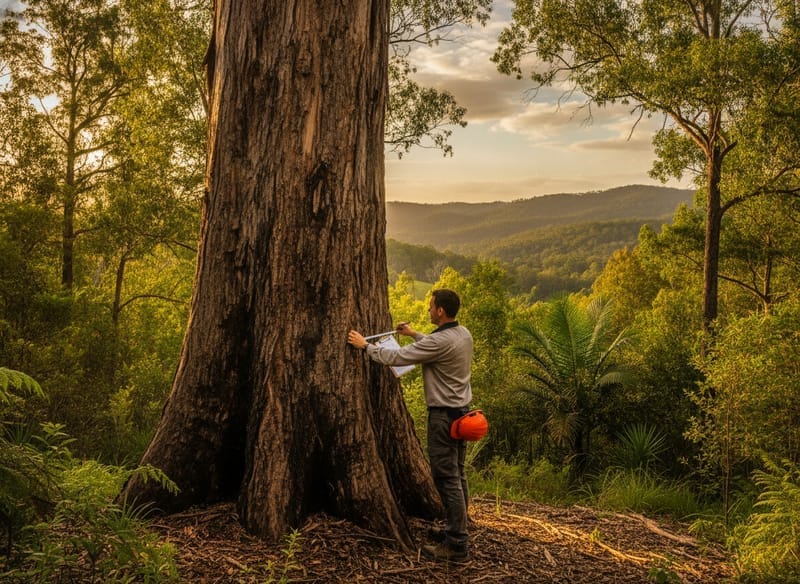
Our Level 5 Arborist attends the Palmyra site to map, measure, and assess the trees.
We calculate Structural Root Zones (SRZ) and Tree Protection Zones (TPZ) as per AS4970.
You receive a comprehensive written report ready for submission to the council or insurer.
If you are planning a property development, managing a large residential block, or dealing with a hazardous declining tree, securing a professional Arborist Report Palmyra is the crucial first step. Palmyra and the wider City of Melville area boast a beautiful mix of remnant native canopy and established mid-century gardens, but these mature trees require expert management as they age and as properties are subdivided.
Our team of AQF Level 5 consulting arborists provides comprehensive, independent tree assessments tailored specifically to local homeowners, builders, and developers. We understand the unique pressures of the Swan Coastal Plain environment, from chronic drought stress on large eucalypts to the strict compliance requirements of modern development applications. When you work with us, you are engaging a dedicated local team of experts. Our deep understanding of Melville's specific planning schemes, soil types, and biosecurity quarantine zones ensures your project starts with accurate, actionable, and legally sound advice.
A common and costly mistake property owners and developers make is relying on unqualified advice or basic lopping quotes when formal documentation is required. In Palmyra, attempting to navigate a development application, a subdivision, or a neighbour dispute without an AQF Level 5 consulting arborist can lead to lengthy council delays, rejected applications, and serious safety oversights.
While the City of Melville Local Planning Scheme No. 6 (LPS6) does not feature a general tree protection overlay for private residential land, building and subdivision projects are heavily scrutinised under R-Codes Volume 1. These codes dictate strict tree canopy and deep soil retention rules. An unqualified tree lopper cannot calculate compliant Tree Protection Zones (TPZ) or Structural Root Zones (SRZ) under AS4970 standards. If your builder encroaches on a tree's root zone without a certified Tree Protection Plan, you risk destroying a mature asset and facing severe compliance action.
Furthermore, the entire City of Melville sits squarely inside the Polyphagous Shot Hole Borer (PSHB) Quarantine Area. A generic assessment might completely miss an infestation in a high-risk host species like a box elder maple or coral tree. Our certified arborists are trained to identify these declared pests and understand the DPIRD compliance rules, ensuring that any subsequent tree removal or pruning work on your property is executed legally and safely without spreading the borer.
Our AQF Level 5 consulting arborists deliver a range of precise, AS4970 and AS4373 compliant reporting services tailored to Palmyra properties and City of Melville planning requirements.
Essential for builders and developers submitting plans to the City of Melville. We conduct a thorough tree inventory, record Diameter at Breast Height (DBH), determine the Safe Useful Life Expectancy (SULE), and provide actionable retention recommendations to satisfy R-Codes Volume 1 deep soil and canopy requirements.
When retaining trees during construction, we map the exact Tree Protection Zones (TPZ) and Structural Root Zones (SRZ). This report specifies mandatory construction fencing, root mapping procedures, mulch protection, and supervised work zones to ensure trees survive excavation and building works.
Utilising Visual Tree Assessment (VTA) and QTRA principles, we evaluate mature trees for structural defects, disease, and environmental stress. This is crucial for large lemon scented gums and remnant tuarts exposed to our severe winter cold front winds and sudden summer limb drop, providing you with documented duty-of-care evidence.
With Palmyra located inside the strict Polyphagous Shot Hole Borer Quarantine Area, we conduct targeted health inspections of high-risk host species like coral trees and box elder maples. We document infestations and provide DPIRD-compliant management or safe removal recommendations.
While private land removals generally do not require a permit under LPS6, a formal report is often required when clearing near remnant vegetation protected by the Environmental Protection Act 1986, or for resolving strata, insurance, and neighbour disputes over structurally hazardous trees.
Delivering an accurate and legally robust arborist report requires a meticulous, structured approach. When you engage our team for a site assessment in Palmyra or the surrounding Melville suburbs, we manage the entire consulting process internally, from your initial phone call to the final document submission. First, we conduct a detailed initial consultation to understand your specific needs. Whether you are submitting a DA to the City of Melville, dealing with a hazardous overhanging branch, or preparing a block for a new subdivision, we clarify the exact scope of the report required. Next, our AQF Level 5 consulting arborist conducts a comprehensive on-site assessment at your property. We meticulously measure trunk diameters, map canopy spreads, and evaluate the overall health and structural integrity of the trees. We specifically look for signs of chronic drought stress, historical topping damage, and local threats like the Polyphagous Shot Hole Borer. Following the site visit, we return to the office for data analysis. We calculate AS4970-compliant root protection zones, cross-reference local zoning under LPS6, and formulate our retention or removal recommendations. Finally, we generate a highly detailed, professionally formatted PDF report. This document includes site maps, high-resolution photography, data tables, and clear, actionable conclusions. We provide this directly to you, ready for immediate submission to your builder, insurance provider, or the local council.
Every report we produce is authored by an AQF Level 5 Diploma of Arboriculture qualified consulting arborist, which is the mandatory standard required by the City of Melville for formal development and risk assessments. We are fully public liability insured and WorkCover compliant, ensuring total protection and peace of mind for our clients.
Our recommendations strictly adhere to AS4970 (Protection of Trees on Development Sites) for all construction-related planning, and AS4373 (Pruning of Amenity Trees) for any structural pruning or canopy management advice. We also maintain strict compliance with DPIRD regulations regarding the processing and movement of green waste within the designated Polyphagous Shot Hole Borer Quarantine Area.
Drafting an accurate Arborist Report Palmyra requires deep knowledge of the local Swan Coastal Plain environment. Palmyra sits on a transition zone featuring limestone-rich Spearwood sand, which heavily influences the root architecture and drought resilience of remnant native species like tuart, jarrah, and marri.
While the City of Melville's current LPS6 scheme does not enforce a blanket tree protection overlay on private residential blocks, property owners must still navigate specific environmental regulations. Remnant native vegetation may trigger protections under the Environmental Protection Act 1986, requiring a clearing permit unless specific exemptions apply. Furthermore, modern block subdivisions must comply with R-Codes Volume 1, which strictly dictates deep soil areas based on retained tree sizes.
Palmyra's Mediterranean climate also drives specific tree hazards. We regularly assess large eucalypts for structural weaknesses exacerbated by powerful winter cold front winds and the risk of sudden summer limb drop on saturated sand. Additionally, our reports carefully factor in the strict movement restrictions of the PSHB quarantine zone, ensuring any recommended tree works do not violate local biosecurity laws.
Once you receive your finalised report, the immediate next step is to submit it alongside your development application or retain it securely for your duty-of-care and insurance records. If the report outlines a Tree Protection Plan, you must implement the specified construction fencing and ground protection before any earthworks or heavy machinery enter the site. Should the assessment recommend remedial pruning, deadwooding, or hazard removal, our dedicated team of AQF Level 3 climbing arborists can safely execute the physical work in strict accordance with AS4373. For retained mature trees, especially large eucalypts exposed to storm winds, we highly recommend calling us back for an updated Visual Tree Assessment every 12 to 24 months.
Arborist reports are quoted based on the number of trees and the complexity of the development.
Contact us for a tailored quote for your specific reporting needs.
Providing consulting arborist services throughout the City of Melville.
Contact us today to discuss your project and get a quote for a Level 5 Arborist Report.
Request a Report Quote